Blog
My website — revised
This site had been running on the same setup for several years now. I kept the content up to date (i.e., adding publications and projects), but never touched the underlying structure. As a consequence, the landing page had grown into a wall of text, the tags were less informative, and finding a specific paper meant endless scrolling. Over the past few days I worked through that backlog with Claude as a coding assistant, which made it feasible to do in an afternoon or two what had been sitting on my list for a long time. Here is what changed, in the order that matters most to you as a reader.
From educational research to psychometrics? A citation update
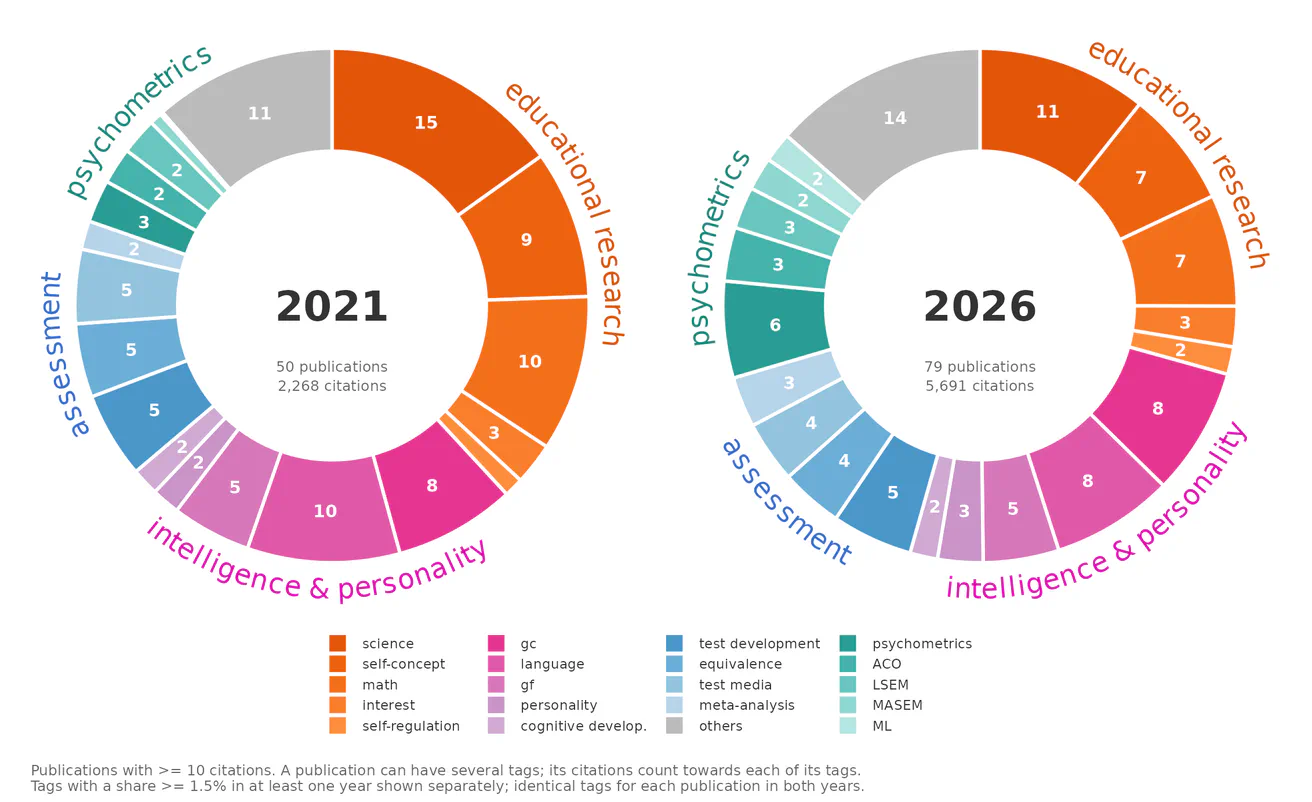
In an earlier post, I looked at which topics of my work are cited on Google Scholar. At the time, I expected that the share of citations from educational research would decrease and that newer topics such as machine learning would show up in the citation profile at some point. Almost five years later, it is time to check whether these expectations hold.
Method
The Google Scholar profile was retrieved with the R package scholar. As before, all publications with at least 10 citations (i10-index) were included (2021: n = 50 publications with 2,268 citations; 2026: n = 79 publications with 5,691 citations). In contrast to the first round, I revised the tags using an LLM: each publication received on average 2.7 tags (range: 1–5) from a set of 34 tags. For example, the article The influence of item sampling on sex differences in knowledge tests is tagged ACO, gc, and gender. To make the two years comparable, the 2021 publications were retrospectively recoded using the same tagging scheme as in 2026, which is why the figures slightly differ.
Bee Swarm Optimization (BSO)
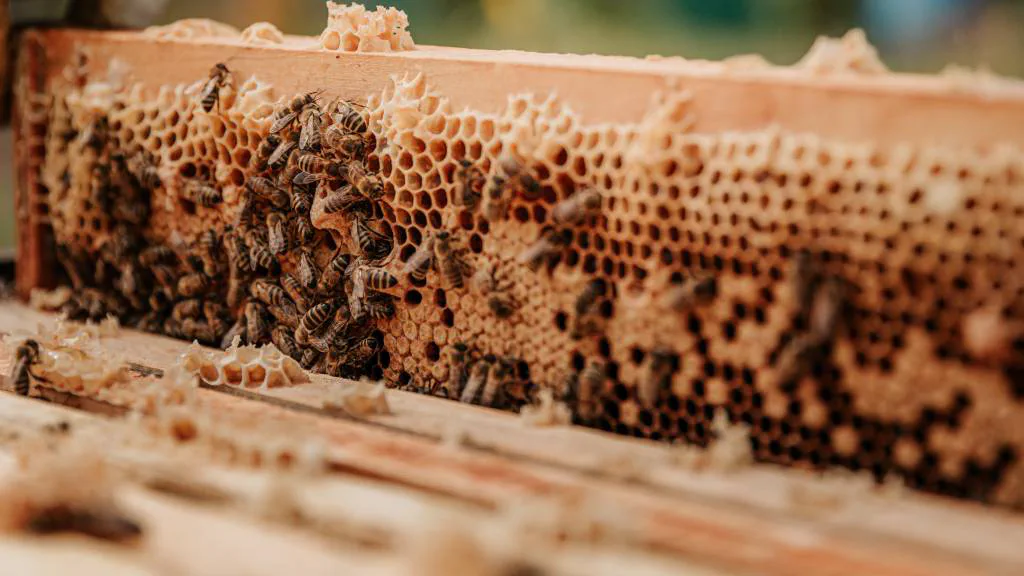 “Bees are amazing, little creatures” (Richardson, 2017) – I agree. Bees have fascinated people since time immemorial, and yet even today there are still novel and fascinating discoveries (see the PLOS collection for some mind-boggling facts). Although bees as an insect species might seem as the prime example of state-building insects, highly social forms of community are the exception among bees. The large majority of all bee species are solitary bees or cuckoo bees that do not form insect states.
Do the citations align with my research interests?
When citations are traded as the currency of science, it is difficult to estimate the price of a publication in advance or to understand it afterwards. One has the impression that precisely the topics that are frequently cited are those not in focus of one’s interest. In contrast, the work that one finds most interesting, might receive little attention. But maybe this perception is biased. To get a better understanding which articles are cited, I would like to give a short bibliometric evaluation of my google scholar citations in this post.
Age-related nuances in knowledge assessment - Much ado about machine learning
 This is the third post in a series on a paper — “Age-related nuances in knowledge assessment” — we recently published in Intelligence. The first post reflected on how knowledge is organized, the second post dealt with psychometric issues. This post is going to be more mathematical (yes, there will be some formulae) and it will be a cautionary note on the use of machine learning algorithms. Machine learning algorithms have positively influenced research in various scientific disciplines such as astrophysics, genetics, or medicine. Also, subdisciplines in psychology such as personality science (e.g., Stachl et al., 2020) or clinical research (Cearns et al., 2019) are adapting the new statistical tools. However, as pointed out in my research statement, every new method initially bears the risk of applying new techniques without the necessary background knowledge. I mainly blame statistical and methodological courses in psychology studies for this. We really have to teach math, stats, and methods more rigorously in university teaching, especially in structured PhD programs.
