From educational research to psychometrics? A citation update
In an earlier post, I looked at which topics of my work are cited on Google Scholar. At the time, I expected that the share of citations from educational research would decrease and that newer topics such as machine learning would show up in the citation profile at some point. Almost five years later, it is time to check whether these expectations hold.
Method
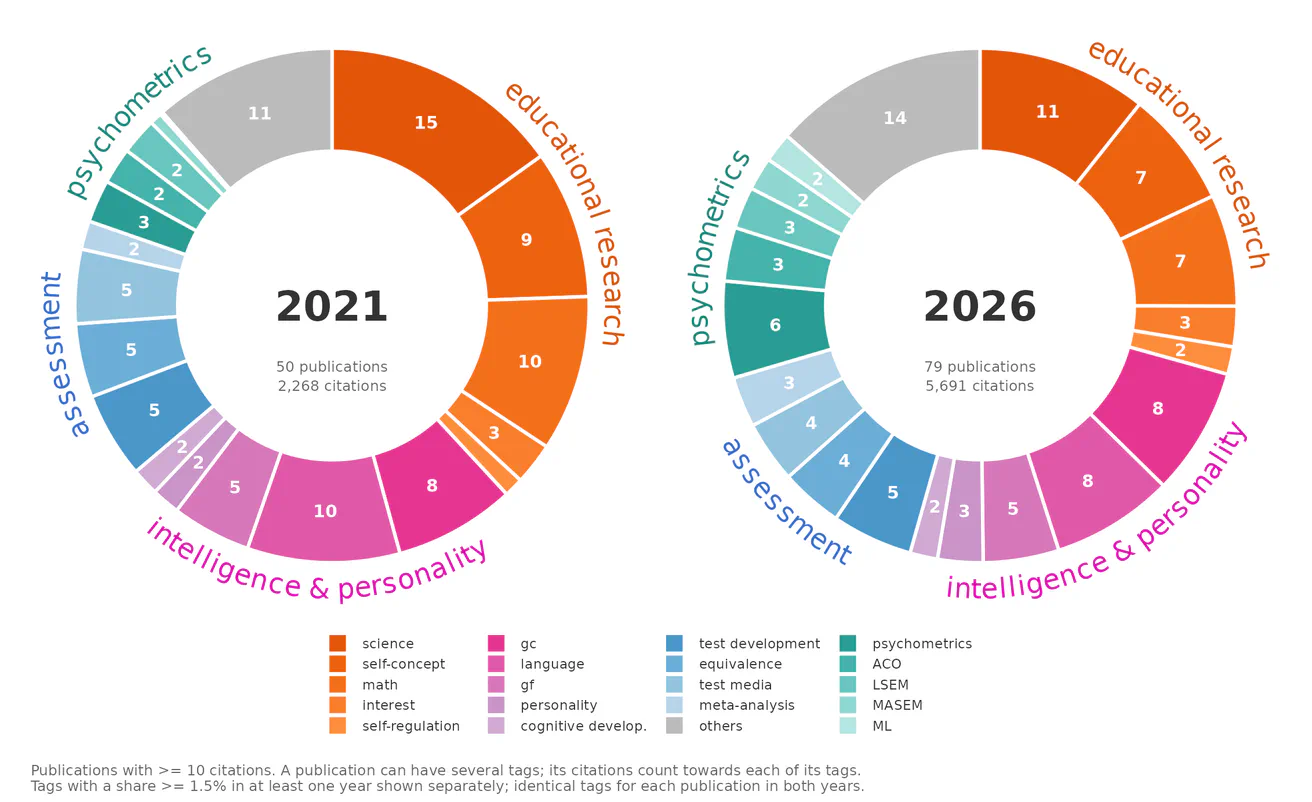
The Google Scholar profile was retrieved with the R package scholar. As before, all publications with at least 10 citations (i10-index) were included (2021: n = 50 publications with 2,268 citations; 2026: n = 79 publications with 5,691 citations). In contrast to the first round, I revised the tags using an LLM: each publication received on average 2.7 tags (range: 1–5) from a set of 34 tags. For example, the article The influence of item sampling on sex differences in knowledge tests is tagged ACO, gc, and gender. To make the two years comparable, the 2021 publications were retrospectively recoded using the same tagging scheme as in 2026, which is why the figures slightly differ.
Each citation to a publication is counted once for each tag assigned to that publication. A tag’s share is then calculated as its citation count divided by the sum of citation counts across all tags. Tags with a share of at least 1.5% in one of the two years are shown separately1. As anticipated in the first post, I have separated the previously combined areas of assessment and psychometrics, the latter encompassing my work on metaheuristics, local and meta-analytic structural equation modeling, and machine learning.
Results
The number of citations has increased by a factor of ~2.5 since 2021. Across areas, the citation profile changed as follows:
-
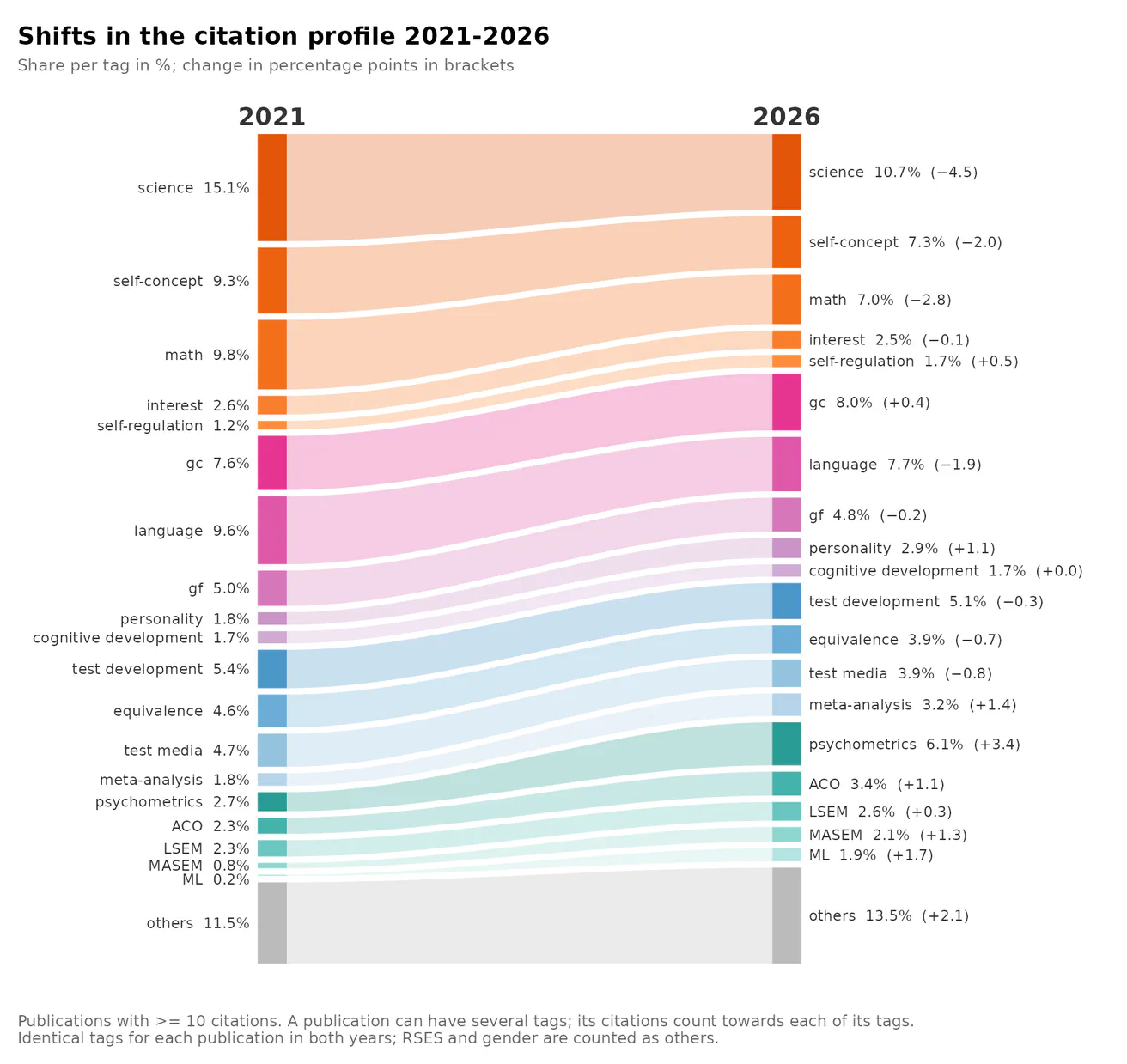
Educational research loses ground. As expected in the first post, the share of educational research declined from 38% to 29% (−9%). This is a relative decline: the absolute citation counts for these tags continued to grow (e.g.,
sciencefrom 946 to 1,715). Of the 18 publications with these tags, 14 appeared in 2016 or earlier, several of them in the context of the IQB national assessment study 2012. -
Intelligence and assessment remain stable. The relative shares of intelligence research (~25%) and of assessment (~16%) remained virtually unchanged. Within intelligence research,
gcremains the largest tag (8.0%). -
The methodological work has become visible. Psychometrics almost doubled its share, from 5.5% to 10.0%. The largest gain across all tags is for
ML(from 0.2% to 1.9%; from 11 to 300 citations), followed bymeta-analysis(+1.4),MASEM(+1.3), andACO(+1.1). Machine learning, which initially even had no tag of its own in 2021, is now part of the citation profile.
TL;DR
Overall, the citations have moved in the direction of my current research interests, but with an immense time lag. Many recent publications, for example on large language models for item development, game-based assessment, or applications of machine learning, have not yet reached the necessary threshold and were therefore not included.
-
Two tags were deliberately assigned to others:
RSES, andgender. ↩︎
